
An image of people discussing how to properly hire an seo specialist for their business, with minimalistic 2D illustrations of relevant SEO images as background, with the help of RuralNative (John Berlin Leonor) guide.
SEO

How to Hire an SEO Specialist in 2025: A 6-Step Guide

Written by John Berlin
Last Updated: December 16, 2025

Table of Content

Hiring an SEO specialist in 2025 is a high-stakes decision—so here are the 6 steps to hiring an SEO specialist perfect for your business.
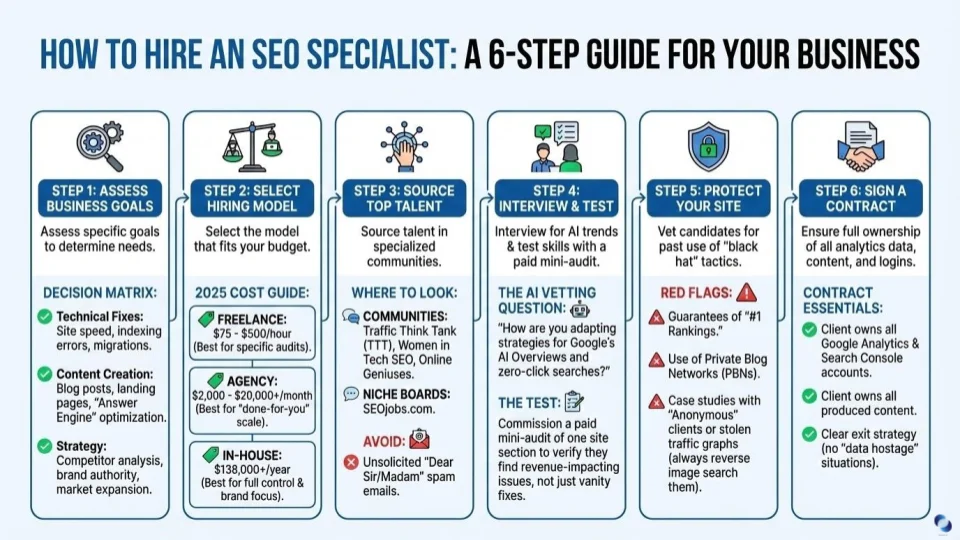
Download the infographoic above for the summarized points!

Key Takeaways

Hiring an SEO specialist in 2025 is a high-stakes decision. Because search engines now use AI to answer questions directly, the skills needed to do the job have changed. To avoid wasting money or hurting your website, you need to look beyond basic promises.

Decide Who You Need: Choose an in-house specialist, an agency, or a freelancer based on your actual budget.
Look in the Right Places: Don’t just post on general job boards. Look in private professional groups.
Ask About AI: Make sure they know how to optimize for “AI Overviews,” not just old-fashioned search results.
Test Their Skills: Instead of just talking, pay them to do a small test project, like a mini-audit.
Check for Danger Signs: Investigate their past work to make sure they didn’t use “black hat” tricks that could get you banned.
Protect Your Data: Make sure your contract says you own all your data, content, and login info.

Why Knowing How to Hire an SEO Specialist Matters

SEO stands for “search engine optimization.” Hiring an SEO specialist can improve your website and save you time, but a bad one can damage your reputation and your site’s ranking.

In 2025, SEO is more than just using the right keywords. It involves technical skills, design, data, and understanding how AI works. Today, Google uses AI to answer questions directly, which changes how people find you.

For business owners, the challenge is finding someone who knows these modern rules. Hiring the wrong person is expensive—not just because of their salary, but because fixing their mistakes takes time and money. If they use outdated tricks, Google might even penalize your site.

The RuralNative Stance: My philosophy is “Foundation First.” Whether you hire me or someone else, never build a marketing campaign on a broken technical foundation.

Step 1: Determine Your SEO Needs

Before hiring anyone, understand what services SEO specialists actually offer:

Reviewing your site: Checking content and structure.
Technical advice: Fixing hosting, redirects, and error pages. (At RuralNative, I call this the “Anti-Bloat” mandate—ensuring your site loads instantly and isn’t weighed down by heavy code.)
Content creation: Writing articles that answer customer questions.
Management: Handling online campaigns.
Keyword research: Finding the terms people actually search for.
Training: Teaching your team how to do basic SEO.
Markets: Expertise in specific locations (local SEO) or industries.

Getting Started with SEO (DIY Resources)

If you run a small local business, you might be able to do a lot of this yourself. Here are free resources from Google:

Video Series: Watch Google’s videos on building an online presence.
Search Essentials: Read about how Google finds and shows web pages.
SEO Starter Guide: This explains what an SEO actually does. Even if you hire someone, skim this so you can spot if they are lying to you.

Important Fact: Paying for Google Ads does not help your organic (free) search ranking. Google never takes money to rank sites higher in search results.

Be Patient: It usually takes four months to a year after making changes before you start seeing real results.

Step 2: Choose Your Hiring Model and Budget

Before you hire, decide what type of help fits your budget.

Option 1: The In-House SEO Specialist (Full-time Employee)

This person works only for you and knows your company well.

Cost: In 2025, a full-time specialist can cost over $138,000 a year (salary, benefits, taxes). In places like Australia, it ranges from $80,000 to $170,000 AUD. Senior specialists who know AI and data can cost over $130,000 just in salary.
Hidden Costs: You also have to pay for their software tools (like Ahrefs or Semrush), which can cost $1,200 to $5,000 a year.
Best For: Big companies with complex websites or companies where writing content is the main way they make money.

Option 2: The SEO Agency

Agencies are teams of specialists. They usually cost less than a senior employee.

Cost: Average cost is around $84,000 a year. Most charge a monthly fee (retainer). Small businesses usually pay $2,000 to $5,000 per month, while big companies often pay $5,000 to over $20,000 per month.
Extra Costs: In competitive industries, you might need an extra budget for PR and getting links, which can add $1,000 to $10,000 per month.
Best For: Small to medium businesses that want a team to handle everything for them.

Option 3: The Freelance Consultant (The Strategic Partner)

Freelancers are individuals you hire by the hour or project.

Cost: Hourly rates are usually $75 to $200. Top specialists can charge $300 to $500 per hour.
Best For: Startups or specific tasks like fixing a technical problem or moving a website.

The RuralNative Advantage: I operate as a Strategic Partner—a hybrid model that gives you “Global Standards” (high-level technical skills) with “Local Grit” (efficiency and work ethic), bridging the gap between a freelancer and a high-cost agency.

Step 3: Find Candidates in the Right Places

If you are redesigning your site or launching a new one, hire an SEO specialist early so they can help build it right from the start.

Where to Look

The best specialists don’t usually hang out on generic job boards like Indeed.

Private Communities: Look in professional groups like Traffic Think Tank (TTT), Women in Tech SEO (WTS), or Slack groups like Online Geniuses and BigSEO.
Niche Job Boards: Sites like SEOjobs.com are built specifically for this industry.

Warning: Ignore Spam Emails

Be careful of emails you get out of the blue claiming they can fix your site. Even Google gets these spam emails! If someone emails you saying, “I noticed your site isn’t listed in search engines,” delete it. It’s almost always a scam, just like emails promising magic diet pills or money transfers from strangers.

Step 4: Interview and Test Candidates

Modern SEO specialists need to be good at data, content, and technical skills.

Questions to Ask

Can you show me examples of your past work and success stories?
Do you follow Google’s official guidelines (Search Essentials)?
What results do you expect, and how long will it take?
How do you measure success?
Do you have experience in my industry or city?
The “Shoes Test”: Do you care about my business problems, or are you just checking boxes? (At RuralNative, empathy comes before code.)
How will we communicate? Will you explain the changes you make to my site?

The 2025 Skill Check: AI and New Search

Search is changing because of AI.

Ask About AI Overviews: Ask them how they write content so that AI engines can understand it. They should talk about answering questions directly and clearly.
Interview Question: “How are you changing your strategy for Google’s AI Overviews?”
Good Answer: They should talk about visibility and being a trusted source, not just getting clicks.

Testing Their Skills

Technical Check: Can they scan a website and find technical errors?
Keyword Knowledge: They should know how to find keywords that actually lead to sales, not just high traffic.

The Paid Trial

Don’t just trust the interview. Pay them to do a small test.

Mini-Audit: Give them access to your data for one part of your site. See if they find real money-losing problems or just tiny, unimportant errors. (At RuralNative, I offer a $300 “Deep Dive” audit for exactly this reason—to diagnose before I prescribe.)
Content Plan: Ask them to write a plan for one important topic.

Are They Interested in You?

A good SEO specialist asks you questions. If they don’t seem interested in your business, find someone else. They should ask:

What makes your business unique?
Who are your customers?
How does your business make money?
Who are your competitors?

Step 5: Screen for Scams and Risks

Some unethical SEOs give the industry a bad name. Using “black hat” tricks can get your site banned by Google. (My “Zero Tolerance” policy strictly forbids these tactics.)

Common Scams to Watch Out For

Buying Links: Never buy links from other sites to boost your ranking. This violates Google’s policies and will hurt you.
Doorway Pages: They put pages full of keywords on your site that don’t make sense for humans. These pages often hide links to their other clients.
Buying Links: Never buy links from other sites to boost your ranking. This violates Google’s policies and will hurt you.
Guarantees: No one can guarantee a #1 ranking on Google. Anyone who promises this, or claims to have a “special relationship” with Google, is lying. There is no such thing as a “priority submit” for Google.

Checking for Danger Signs

In 2025, Google’s AI is very good at catching cheaters.

Fake Networks (PBNs): Check the websites they worked on before. If they used a network of fake blogs to create links, avoid them.
Fake Case Studies: Be careful if they show results for “anonymous” clients. Use Google Image Search on their graphs to make sure they didn’t steal the picture from someone else.
Vanity Metrics: Be wary if they only talk about “impressions” (how many times your site was seen) but can’t show that it led to more sales.

How to Report Scams

If you were tricked by an SEO specialist:

You Own Everything: The contract must say clearly that you own all your accounts (Analytics, etc.) and all the content they create. They are just looking after it for you. (At RuralNative, this is standard—you always hold the keys.)
Clear Goals: Don’t accept vague promises like “ongoing services.” List exactly what they will do (e.g., “4 blog posts a month”).
Leaving: Make sure there is a plan for what happens if you end the contract. (I prefer Month-to-Month contracts—I earn your business every 30 days.)
Legal Protection: The contract should say that if they steal content or use copyrighted images and you get sued, they are responsible.

Step 6: Finalize Hiring and Contracts

Check References

Ask their past clients if they were happy. Ask the candidate for a “technical audit” of your site to see what they would fix. You will likely have to pay for this. Give them “read-only” access to your data at first—do not give them full control yet.

The Contract

A professional contract protects you.

Fake Networks (PBNs): Check the websites they worked on before. If they used a network of fake blogs to create links, avoid them.
Fake Case Studies: Be careful if they show results for “anonymous” clients. Use Google Image Search on their graphs to make sure they didn’t steal the picture from someone else.
Vanity Metrics: Be wary if they only talk about “impressions” (how many times your site was seen) but can’t show that it led to more sales.

Know Where the Money Goes

Some search engines let you pay to appear in results. Google does not. Make sure you know if your money is going towards permanent improvements (SEO) or temporary ads.

Measuring Success

In 2025, stop looking at “rankings” and “domain authority.” Start looking at business results:

Revenue: How much money did organic search make you?
Conversion Rate: Are the visitors actually buying things or signing up?

Conclusion

A Filipino freelancer providing website development services to a client on his laptop at his own home office.

Hiring an SEO specialist in 2025 is about managing risk. You need someone who understands the new AI world and follows the rules. Do your research. While Google doesn’t recommend specific companies, be careful of anyone who acts unprofessionally.

Simple Checklist for Hiring an SEO Specialist:

Decide: Do you need a freelancer, an employee, or an agency?
Search: Look in specialized groups, not general job sites.
Ask about AI: Make sure they understand the new search landscape.
Test: Pay for a small trial project first.
Check Backgrounds: Look for any history of using banned tricks.
Contract: Ensure you keep ownership of your data.
Measure: Focus on sales and leads, not just rankings.

A Note from RuralNative: At RuralNative, I operate as a Strategic Partner. I strictly adhere to these protocols—no guarantees, no shadow domains, and full client ownership of all data. If you are ready for an SEO relationship built on “Global Standards and Local Grit,” review my service portfolio below.

Stop Managing. Start Partnering.

If you are ready to work with a Filipino SEO and website development specialist who cares about your business as much as you do, let’s talk.